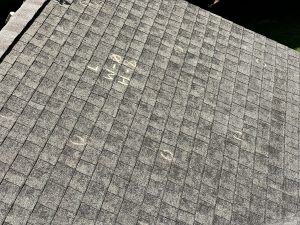
A roof marked with hail damage spots
If you want a professional opinion, start here: schedule a free storm damage inspection with our team at 4 Elements Renovations.
👉 https://4elementsrenovations.com/services/storm-damage-restoration-services/
What Counts as “Severe” Hail (and Why That Matters for Roofs)
The National Weather Service generally considers a thunderstorm “severe” when it produces hail 1 inch in diameter or larger (about quarter-size) or damaging winds. That 1-inch threshold matters because roof damage becomes much more likely as hail gets larger and impact energy increases.
Helpful hail size guide (visual comparisons):
👉 https://www.noaa.gov/jetstream/ll-hailsize
Severe thunderstorm definition reference:
👉https://www.weather.gov/bmx/outreach_svr
7 Common Signs of Roof Hail Damage (What We Look For)
Hail damage isn’t always dramatic. A roof can look “fine” and still have compromised shingle integrity. During a hail damage roof inspection, we typically look for:
1) Granule loss / exposed asphalt
Dark spots or “bruising” where granules were knocked off.
2) Shingle bruises (impact marks)
Soft spots that feel spongy or fractured under the surface.
3) Cracked shingles or shattered mat
More common on older roofs or brittle shingles.
4) Damaged flashing and roof penetrations
Dents or bending around chimneys, pipe boots, skylights, and valleys.
5) Dented roof vents, turbine vents, or metal accessories
Soft-metal dents are often the easiest “proof” of hail impact.
6) Gutter and downspout dents
Hail frequently shows up on gutters before you notice roof issues. (If you’re already seeing gutter problems, our gutter services are here: https://4elementsrenovations.com/services/gutter-services/)
7) Interior clues (late-stage)
Stains, damp insulation, or musty smells—usually after damage has had time to develop.
If you’re unsure, it’s worth getting documentation early.
👉 https://4elementsrenovations.com/services/roof-repair-services/
What To Do Right After a Hail Storm (Simple Checklist)
Here’s a homeowner-friendly checklist that helps protect your claim **and** your home:
Step 1: Prioritize safety
If storms are still active, stay sheltered and away from windows.
NWS hail safety tips: https://www.weather.gov/mlb/hail_rules
Step 2: Take “ground evidence” photos
From the ground, safely photograph:
– Dents on gutters/downspouts
– Dents on AC fins (avoid touching; they bend easily)
– Dents on metal vents/flashings you can see
– Hail stones (if present) next to a coin for size reference
Step 3: Don’t climb the roof
Roof surfaces can be slick after storms, and walking can cause additional damage. A professional inspection is safer and cleaner for documentation.
Step 4: Schedule a documented roof inspection
A proper storm inspection should include photos, slope-by-slope notes, and a clear recommendation (repair vs replacement).
Start here: https://4elementsrenovations.com/services/storm-damage-restoration-services/
Roof Repair vs Roof Replacement After Hail: What’s Usually “Worth It”
Not every hail event means you need a full replacement. In general:
Roof repair may be enough if:
– Damage is limited to a small area
– The roof is relatively newer
– Issues are mostly flashing/penetrations or a few shingles
Replacement is more likely if:
– Hail damage is spread across multiple slopes
– You have widespread granule loss/bruising
– The roof is older and already near end-of-life
– Multiple components were hit (shingles + vents + flashing)
Either way, the key is an honest inspection and clear documentation—then a plan that actually makes sense for your home.
Learn more about how we operate and support homeowners:
👉 https://4elementsrenovations.com/why-us/
Can You Prevent Hail Damage? (You Can Reduce Risk)
No roof is “hail-proof,” but some choices can reduce future risk:
– Keep your roof maintained and inspected (small issues become big ones after storms)
👉 https://4elementsrenovations.com/roof-maintenance-the-ultimate-guide/
– Consider impact-rated roofing options when it’s time to replace
The Insurance Institute for Business & Home Safety (IBHS) tests shingles for impact resistance and publishes research/ratings:
👉 https://ibhs.org/hail/relative-impact-resistance-of-asphalt-shingles/
Local Roof Hail Damage Help in Gallatin & Middle TN
If you’re in Gallatin, Hendersonville, Lebanon, Mt. Juliet, Goodlettsville, or the greater Middle TN area, 4 Elements Renovations can help you move from “I think we got hit” to a clear, documented plan.
✅ Free storm inspection
✅ Photo documentation & honest recommendations
✅ Storm damage restoration support
Contact us here: https://4elementsrenovations.com/contact/
Or call/text: 615-855-7240
FAQs About Roof Hail Damage
How do I know if my roof has hail damage?
Look for granule loss, bruised shingles, dents on soft metals (vents/gutters), and flashing damage. The safest answer is a documented inspection.
What size hail damages shingles?
Damage becomes more likely as hail gets larger; the NWS often uses **1-inch hail** as part of the “severe thunderstorm” definition.
https://www.weather.gov/bmx/outreach_svr
If I don’t see leaks, am I fine?
Not always. Hail can compromise shingles and flashing without immediate interior leaks.
Should I tarp my roof after hail?
Only if there’s active leaking or exposed decking—and it should be done safely and correctly. We can advise after inspection.
Sources (Outbound)
– NOAA JetStream hail size guide: https://www.noaa.gov/jetstream/ll-hailsize
– National Weather Service severe thunderstorm definition:https://www.weather.gov/bmx/outreach_svr
– National Weather Service hail safety rules: https://www.weather.gov/mlb/hail_rules
– IBHS shingle impact resistance research: https://ibhs.org/hail/relative-impact-resistance-of-asphalt-shingles/